|
|

Services
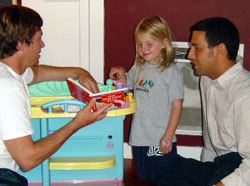 Family Therapy: Family Therapy:
- For Whom? A family (two or more
people living together) struggling with communication issues,
separation, loss, trauma, fighting, illness, developmental
changes, conflict, parenting issues, acting out behavior,
drug abuse, discipline issues, etc.
- How it works? The family is
a small community where issues affect everyone. The work
focuses on developing communication and understanding to
identify the conflict in the family. It is important to
define the rules, roles, and boundaries within the family.
Develop consistent strategies for setting appropriate limits,
rewards and consequences, and incorporating structure, routine
and rituals.
- What to expect? A family environment
that allows for communication, promotes individuality as
well as a sense of belonging, respects differences, provides
support, and shares positive and negative experiences equally
well.
Couples’ Therapy:
- For Whom? Relationship issues,
premarital counseling, parenting conflicts, intimacy issues,
life changes, career planning, financial issues, and substance
abuse.
- How it works? Exploring individual
styles of expressing and receiving thoughts and feelings.
Understanding the influence of each person’s family
background. Developing the ability to listen, receive feedback,
and resolve conflict. Utilizing the unique strengths of
the relationship as defined by each person’s attraction
to one another.
- What to expect? A couple that
is able to acknowledge and maximize the most of their compatibility.
A balanced relationship that allows for openness, empathy,
respecting each others’ thoughts and feelings, playfulness,
intimacy, and healthy independence and dependence.
Child and Adolescent Therapy:
- For Whom? Persons between the
age of 3-19 who are experiencing anxiety, depression, difficulty
with separation, ADHD, socialization issues, trouble with
communication skills, low self-esteem, difficulty with peer
relations, conflict with parent-child and/or sibling relations,
issues with respect and/or responsibility, attentiveness,
bullying, and school-related behavioral problems.
- How it works? Working with younger
children (age 3-8) involves a collaborative approach with
parents, teachers, and other caregivers. Initially, it
is important to understand the context in which the child
is having difficulty (See Behavioral Assessment). The therapy
utilizes art and play therapy to explore issues that the
child is unable to express in words. The child learns new
ways of coping or responding to difficult situations through
social skill training, role-play, self-esteem exercises,
art and play therapy. Parents and other caregivers also
learn how to provide safety and containment by utilizing
behavioral contracts, modeling how to respond to the child,
setting appropriate limits, mirroring/empathy, and developing
structure and routines.
- Children and adolescents (age 9-19) may attend therapy
individually, along with collaborative sessions with parents/family.
This type of therapy is more for young people who are able
to identify that something is bothering them (sad, anxious,
no friend, school problem, family issues, etc.), and are
self-motivated to get help and attend therapy.
- What to expect? Child/Adolescent
therapy helps to identify the triggers of the problem, add
what is needed to support the child’s success, and/or
remove negative factors. It usually involve subtle, yet
profound, shifts in the child’s environment and internal
coping abilities that allow the child to positively experience
family, friends, school, success, and challenges.
- How do I get my child to go to therapy?
Some children are able to identify that there is a problem
(or not), but do not want to go to therapy. Parents should
explore the severity of the problem with each other and
the child (depending on age and maturity). It then becomes
an opportunity to model how to make an informed decision.
Parents should encourage the young person to attend 2-3
sessions, with or without you, and then decide if therapy
would be a helpful solution. As parents, we must sometimes
act in the best interest of our children by acknowledging
when a child is not able to make a mature decision about
going to therapy, and explaining that the child needs to
participate in therapy until the problem is resolved, mood
is elevated, behavior improved, etc.
- Can parents benefit from therapy without
children? If the child is clearly against
therapy, it can still be very helpful for parents to develop
a better understanding of their parenting style and relationship
with their child(ren). Parents can gain a better perspective
of the family issues, develop insight into how to positively
impact the situation, and gain new skills and techniques.
Specialized Services
Pro-Active Parenting/Parenting Issues:
- For Whom? Parents who need help
with acting out behaviors, sibling conflict, developmental
changes, discipline, behavioral assessment, developing structure/routine,
and special needs.
- What is Pro-Active Parenting?
It is a parenting technique that helps parents to establish
a way of responding and anticipating to children’s
needs. Pro-Active parenting provides clarity about the parent
and children’s roles, responsibilities, expectations,
consequences, and necessary communication.
Divorce/Family Conflict; Co-Parenting:
- For whom? Parents and children
(ages 3-19) who have/are experiencing parental divorce/separation.
Children experiencing behavioral and/or emotional difficulties
as a result of family separation and/or other family trauma.
- Co-Parenting? Separated or divorced
parents learn how to focus on the needs of the child. Developing
strategies, decision-making tools, and routines to help
parents effectively cope with emotional issues of separation
and emphasize the best interest of the children.
Socialization Issues for Children and Adolescents:
- For whom? Children having trouble
with communication skills, low self-esteem, peer relations,
parent-child and/or sibling relations, school behavior,
issues with respect and/or responsibility, attentiveness,
bullying.
- Ages? 3-19 years old
In-Home Family Therapy:
- Why In-Home Family Therapy?
The home is the natural context where the family establishes
the fundamental relationships that reverberate into the
community (i.e. school, work, peer relations).
- How does it work? In-home family
therapy explores the family structure, rules, rewards, style
of communication, time management, and behavioral/disciplinary
issues to strengthen the family bond.
Behavioral Assessment:
- Why? This service is for parents
who have already attempted therapy, or other means, to improve
their child’s behavior, and have received little or
no results. The focus of a behavioral assessment is an extensive
investigation to clearly identifying the issues and appropriate
method(s) of treatment.
- What is it? A behavioral assessment
analyzes the context of the child’s behavioral issues
to identify the triggers and focus of treatment. It is a
process that includes observation in school, at home, and
in the community (i.e. extra-curricular activities). Dr.
Stein will interview counselors, teachers, parents, coaches,
caregivers, and other people who have a keen awareness to
the child’s behavior. This includes consultations
with doctors, neurologists, principals, and other professionals.
Lastly, there is a review of schoolwork, testing, artwork,
medical records, and any other relevant material.
- What to expect? Identify factors
that are impacting the behavior, underlying symptomology,
diagnostic picture, and clear treatment plan. This would
include appropriate referrals, testing, medical considerations,
academic considerations, and extra-curricular activities.
|
|

